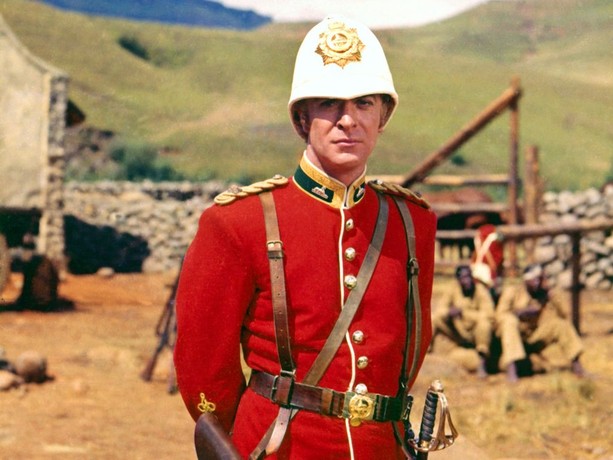
Zulu (1964) is epicness of an English sort. It was a vehicle for the Welsh actor, Stanley Baker and a start up the ladder for a Cockney one (Michael Caine).
Forward: Originally posted back in 2012.
A kind of ‘retro’ retro review today. My daughter and I watched this magnificent film again last night. It is an eternal favorite in this house and has been for a long time.
For those of you who might live under a rock or perhaps on some planet where television signals don’t reach, Zulu is a 1964 historical war film depicting the Battle of Rorke’s Drift between the British Army and the Zulus in January 1879, during the Anglo-Zulu War. It was produced as a joint venture with Stanley Baker‘s production company Diamond Films.
Cy Enfield directed Zulu. He was blacklisted in Hollywood by the HUAC. They decided that he was an ‘sympathiser’ to the ‘red peril.’ AKA the communist party. Something the industry was hysterically trying to stamp out in the 1950’s. Enfield left the USA and set up shop in the UK IN 1951. The producers were Stanley Baker, Cy Enfield and Joseph E Levine.
The film is shot using the Super Technirama 70 cinematographic process. It was distributed by Paramount Pictures in all countries excluding the United States, where it was distributed by Embassy Pictures. Technirama was obviously a good choice as the film still looks magnificent. The colours are rich and full and the film feels panoramic to the extreme.
My name is Michael Caine
All the exteriors of Zulu were filmed in South Africa. The interiors were done at at Twickenham Studios in England. Michael Caine (in his first ‘starring’ role, “Introducing Michael Caine”) writes about the experience in his first Autobiography, What’s it all About? Caine tells us the ‘locals’ were treated abysmally. Stanley Baker was furious about it.
He also talks about the ‘spies’ the South African Police had mixed with the local film crews. It was a deplorable time in South Africa’s social and political history.
Caine also writes about the weeks of waiting by the film crew and cast because of rain. He also talks of his own personal trials and tribulations on his first big role.
*If you haven’t read Michael Caines Autobiography, I strongly urge you to do so. He talks a great deal about Zulu and other films he has worked on as well as personal aspects of his life. He was a firm favorite of mine before he wrote the book, after reading it, I became a firm devotee of the man’s work.*
Despite the political problems faced by the production crew and (in some cases) the cast. The film was finished and shown to rave reviews and huge box office returns.
Poetic license
There were a few folks who were less than delighted by the portrayal of some of the ‘real’ characters in the film. The screenplay was adapted from an article about Rourke’s Drift written by John Prebble. Cy Enfield talked to the Zulu historians to get a picture of the battle from ‘both sides’ and he and Prebble came up with the finished script.
Historical license was taken with some of the characters in the film to either enhance their story or to make it more poignant. The Wittes and Private Hook in particular were changed to fit the mood of the film and to make the character cinematically more interesting.
Some things were ‘made up’ for the same reason. There was no instance of the two groups ‘singing’ at each other and the Zulu’s did not, in fact, ‘salute the soldiers’ for their bravery. But in true Hollywood style it looks brilliant and moves the film on nicely. In other words, “If it wasn’t like that brother, it should have been.”
The cast a compilation of some of Britain’s finest actors:
- Stanley Baker as Lieutenant John Chard
- Michael Caine as Lieutenant Gonville Bromhead
- Jack Hawkins as Reverend Otto Witt, a Swedish missionary based at Rorke’s Drift
- Ulla Jacobsson as Margareta Witt
- Chief Mangosuthu Buthelezi as King Cetshwayo
- James Booth as Private Henry Hook, described as “a thief, a coward, and an insubordinate barrack-room lawyer”
- Nigel Green as Colour Sergeant Frank Bourne
- Ivor Emmanuel as Private Owen, a Welsh baritone and head of the company choir. At the end, Owen leads the men in singing “Men of Harlech”.
- Paul Daneman as Sergeant Maxfield
- Glynn Edwards as Corporal William Allen, portrayed as a model soldier (despite the real Allen being recently demoted from Sergeant for drunkenness)
- Neil McCarthy as Private Thomas
- David Kernan as Private Frederick Hitch
- Gary Bond as Private Cole
- Peter Gill as Private 612 John Williams
- Patrick Magee as Surgeon-Major James Henry Reynolds, the overworked doctor
- Richard Davies as Private 593 William Jones
- Denys Graham as Private 716 Robert Jones
- Dickie Owen as Corporal Christian Schiess, a hospitalised Swiss corporal in the Natal Native Contingent
- Gert Van den Bergh as Lieutenant Josef Adendorff, an Afrikaner officer serving with the Natal Native Contingent and a survivor of the battle at Isandhlwana
- Dennis Folbigge as Commissary James Langley Dalton
- Larry Taylor – Hughes
Action
The action scenes are brilliant considering the Zulu tribesmen had never acted before. Since Stanley Baker viewed the film as a western, the producers brought in a western film for the tribesmen to watch so they could see how the action sequences were to look and how to ‘die’ on film.

The film opens and closes with the magnificent voice of Richard Burton (who was a close friend of Stanley’s) and a fellow Welshman. He tells of the massacre of British troops at the Battle of Isandlwana. At the end of the film he details a brief history of the Victorian Cross. He then reveals which of the men who fought at Rourke’s Drift were awarded the medal.
History
This epic film is about an out-numbered group of British soldiers (150 soldiers and 4000 Zulu warriors). Their desperate battle to keep from being overrun by the Zulu’s and their eventual ‘victory,’ is a true timeless masterpiece.
I defy anyone to watch the film and not come out in gooseflesh at the ‘train noise’ the advancing Zulu warriors make as they approach the Drift or to see the scenes of the Zulu chanting and striking their cowhide shields as they prepare to charge the soldiers. These scenes alone are worth the price of admission (so to speak).
The makeup, the costumes and the set all scream out with authenticity although the river that Chard is to build a bridge over is laughably small and looks more like a dammed section of a small creek. I do know there were some technical problems with the actual river and unfortunately it shows.
But water difficulties aside, Caine absolutely knocks it out of the park in his first starring role. At the beginning of the film you cannot stand his character and by the end of it you like and admire the man. Baker is as resolute and as firm as an oak tree, using his engineer skills to build a way to defend the Drift with wagons and ‘mealie’ (corn) bags.
Special mention goes to
Nigel Green as the colour sergeant also trumps the rest of the cast, but James Booth (as Private Hook) who did not even get to film outside of England comes a close second to Green in performance.
If you want to see a film that shows ‘how they used to make em’ watch Zulu. In fact, if you are an aspiring young film maker, I would make it a requirement to study this film. Well, this film and Terminator 2: Judgement Day on how to make a action movie work.

Michael Smith 12/10/2012
Postscript: I just realised that I have not mentioned the exquisitely epic score and soundtrack by the magnificent John Barry (perhaps better known as the creator of the ‘Bond’ music). Mea Culpa to the estate and survivors of messer Barry (3 November 1933 – 30 January 2011). How could I forget when the music was playing through my head while I wrote this.
.


Leave a Reply
You must be logged in to post a comment.