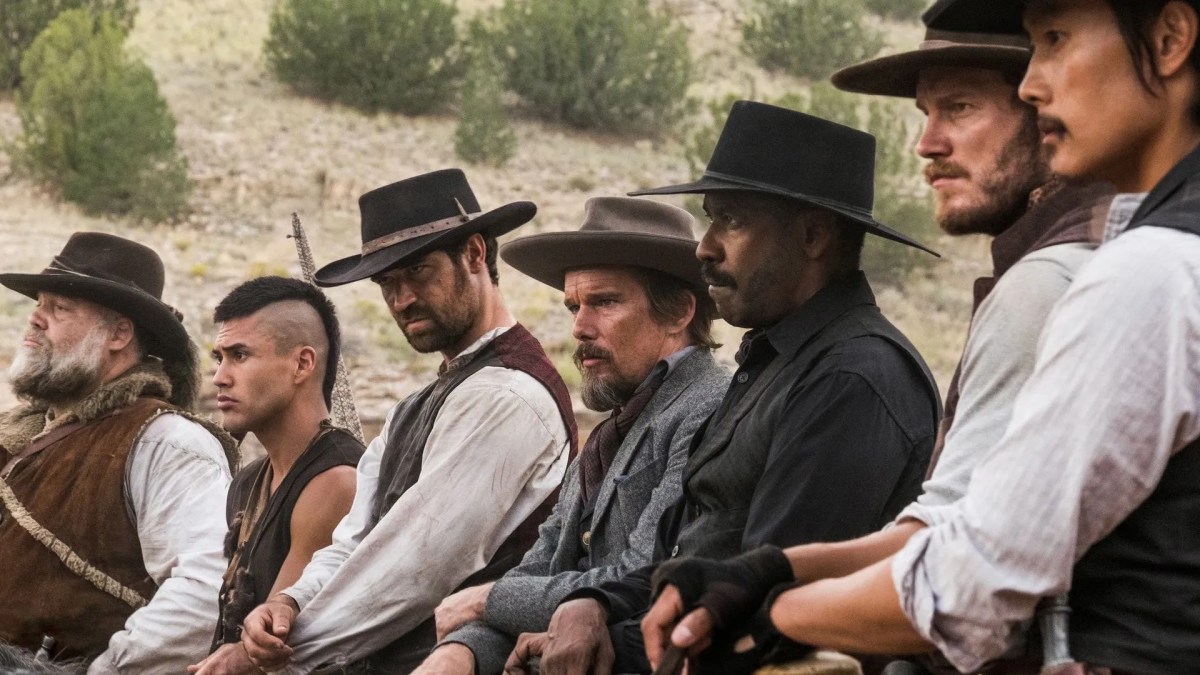
2016 saw the tepid remake of The Magnificent Seven and it fails, miserably. Hollywood continues to travel on the remake train. There are still rumours of re-imagining of The Wild Bunch still bouncing around the ether. The demise of Tony Scott who was to helm the picture has not stifled this one. The new take of The Magnificent Seven fails on several levels. Not as a western, per se, but as a remake of an original classic that was itself a remake.
The Story Behind the Story of the Seven
Akira Kurosawa was a fan of the American western, specifically John Ford’s films. He made Seven Samurai and also went on to make Yojimbo. Yojimbo was the film that Italian filmmaker Sergio Leone turned into A Fistful of Dollars. That started the “Dollars” trilogy, that started Clint Eastwood on his rise to stardom. It also aided his eventual transmutation into a film icon.
Hollywood liked the western premise of “Seven Samurai” so much that they decided to make their own “westernized” version. They re-adapted Kurosawa’s love letter to the American West. John Sturges directed a script adapted by William Roberts; presumably based upon Akira’s original screenplay.
Long Winded
The “Seven Samurai” feels very western-ish with its Samurai heroes. They are in reality Ronin. Samurai without masters who are roaming the land and accomplishing little for money. They still have the “code of honor” that they live by, or at least try to live by.
“SS” is slow and meandering and quite epic. It is also very verbose. All Japanese films at that time, even “Yojimbo,” featured heroes and villains who talk a lot. There are overly long speeches about everything, even before an attack. Generally, the participants talk the issue to death before turning to sword play.
The Sturges film got rid of all the heroes long winded pontification and kept dialogue to a minimum. Yul Brynner plays the main gunfighter (Samurai) and recruits six other men. They then help the beleaguered villagers, and does so without resorting to long speeches.
Later in the film, there is a time for a “long” speech. Brynner’s leader and the other gunfighters explain why their life is not one that anyone should envy. Each of the “Seven” give their short spin on the lifestyle.
Each of the gunfighters in the Sturges remake are like the Ronin from the Akira Kurosawa film. All have a code and each one has accomplished little in the recent months. The men also have a code of honor that they follow. However, they find that their worth has diminished somewhat.
As the Charles Bronson character; Bernardo O’Reilly says, “Right now $20 is a lot of money.” The leader Chris states that no one has given him “everything” before, leading to all the men to help. They take a chance to do the right thing for people who need their help.
Mexico Not Happy
Mexico was not overly pleased with how the Mexican villagers were depicted in the film. Men with no weapons and little knowledge of the world outside their farms and families. However, the tale needed to be intimate, simple and, at the same time, epic.
Sturges understood that the very nature of this film depended on the intimate setting of the village. He understood that the naivety of the people was essential to the story. . This naivety even extends to the bandit leader. We learn he really steals from the unfortunate villagers to feed his men.
It is a case of survival for both the heroes and the villains. Even Chris and his magnificent seven gunfighters are doing the job for the “food and board” more than anything else.
The bare minimum of recompense and reward is what turned this film into an instant classic. That and the performances of all the players. Brynner, Steve McQueen, Bronson, Eli Wallach, Brad Dexter,. Along with Horst Buchholz, Robert Vaughn and James Coburn all turn in brilliant performances. Each one a shaded nuance of their Samurai counterparts. It is this, along with the script and direction, that makes this slow moving and simple western a massive hit.
Bigger is Not Better
Antoine Fuqua works on the premise that bigger is better for the remake. The screenwriters (Richard Wenk and Nic Pizzolatto) hark back to the original screenplays. The overall feeling is a mishmash of Spaghetti Western ambiance with a lot of Hollywood Western cliches.
Chris is now Sam Chisolm played by Denzel Washington. Sam is a warrant officer for the court. He has a connection with the villain of this piece, played by Peter Sarsgaard. Somewhat irritatingly, in a bit of backstory, Sarsgaard’s character hired men did a poor job of hanging Sam Chisolm. This act turns the whole thing into a Hang ‘Em High type scenario at the end. This move detracts from the whole message of both the original and the 1960 remake.
This new version moves the action from south of the border and turns the farmers into terrorized town folk. Bartholomew (Sarsgaard) who wants the gold and all the land to himself. This move alone creates a new problem. It is set just after the Civil War. At that time many of the townspeople were not helpless sheep, as depicted in the 2016 film.
The Old West
Louis L’Amour points out in many of his books about the old west a certain truth. Towns were filled with old campaigners who had fought in several wars. This included taking on the indigenous population that the white man forced off their tribal lands. No one, in the real west, would have allowed Bartholomew’s hired guns to run roughshod over their town.
The film’s move to make corporate greed the main motivation for the villain, inadvertently enters “Pale Rider” territory. The Eastwood nods do not end there. The film’s opening shot of Chisolm has him riding through a heat shimmer. Very similar to another Clint Eastwood western, “High Plains Drifter. ” A 1973 western that also dealt with gold as its prevailing plot line.
We Lost the Characters
None of the original characters are transferred wholly from either film to the new “Seven.” There is the Robert Vaughn character Lee. Played by Ethan Hawke, This man is not a gunfighter at all. He is a sniper. James Coburn’s character, a variation on the master swordsman in Kurosawa’s classic, is replaced by Byung-hun Lee. Lastly, there is no Horst Buchholz character at all.
There are things that stand out with Fuqua’s vision of Magnificent Seven. He has included some Native American characters. His Mexican member of the team is no neophyte but is instead a hardened killer. The token female – Haley Bennett, who plays recently widowed Emma Cullen, is one tough piece of work.
What is missing are the clean lines put forth by Sturges’ film. The intimacy is gone and been replaced with huge shoot outs that includes all the well-armed townspeople. They include dynamite and a gatling gun, oh so reminiscent of Sam Peckinpah’s The Wild Bunch. There is also a 150 strong army of hired gunfighters, the epic intimacy has been thrown out the window.
In this film, the villagers are not so much learning what they must do to survive against an outside evil. They are fighting against corporate greed and an inflated ego. Sarsgaard’s character in this film is an old west version of Donald Trump. This move exacerbates the change of victim.
No Oomph
Ultimately, the film lacks the oomph of Sturges’ version. It feels more like a misguided homage to Sergio Leone than to Akira Kurosawa. The Elmer Bernstein score, from the 1960 film is only used during the end credits. This also effects the film.
The actors in the film all do well. However, they lack the stoic and taciturn quality of the western heroes in the original “Seven. ” They all bring much to their roles, but, the screenplay lets them down.
The 2016 version of The Magnificent Seven, features huge shootout. One that leaves the streets of the one-horse town littered with bodies. Despite this it just does not work. It is, in the end, a little boring and more of an oddity than a brilliant re-imagining of two classics.
By having a connection between the “Mexican bandit” (Bogue) and the new Yul Brynner character changes everything. The film loses the nobility of the characters and the storyline of both Sturges’ film and Kurosawa’s.
The Verdict
Despite the high scores on IMDb, the film, with so many influences is only a 3.5 star film. *There is even a little Tarantino in there.* The film is streaming on Prime and MGM Plus. It is reasonably enjoyable but not overly so. Watch once and then move on.


Leave a Reply
You must be logged in to post a comment.