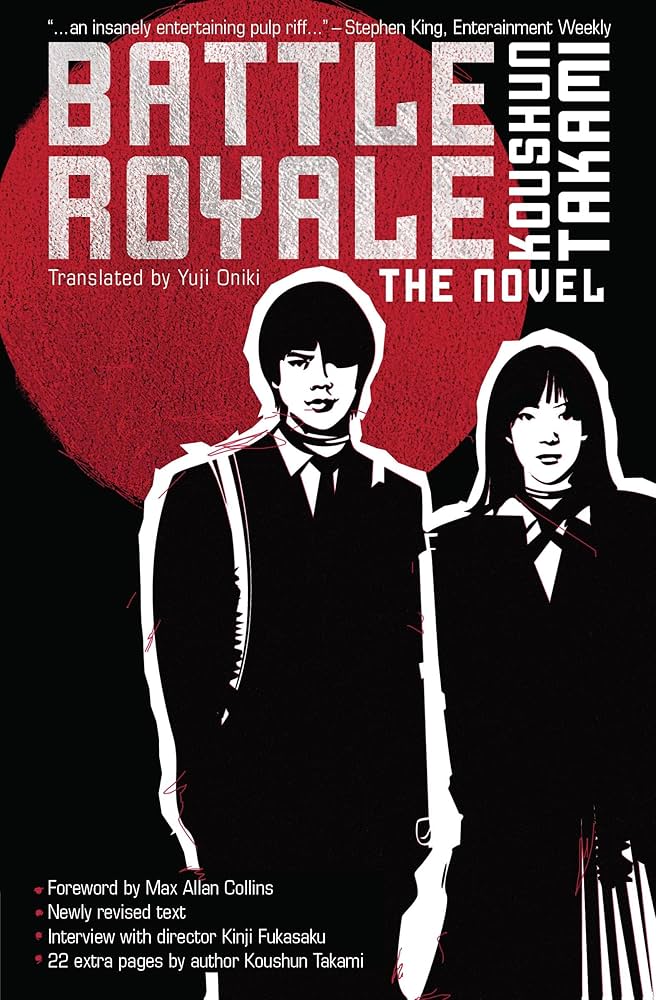
Originally published in 1999 Battle Royale is Koushun Takami with his version of an apocalyptic world. The novel was released amid a flurry of controversy that would rise to a cacophony when a film one year later was adapted from the novel.
The book still packs one hell of a punch. The story of a group of Junior High School students made to kill each other off until only one remain.. This story still shocks and astounds 13 years after its first appearance in bookstores and libraries across the world.
Reading the book and watching the film of The Hunger Games written by Suzanne Collins, I find it hard to believe that she never heard of either one. The original story or film, made by the iconic Japanese director Kinji Fukasaku. I am sure that she is telling the truth. There are enough instances of the two stories, Collins has spread the Hunger Games stories over three books, being vastly different. However, there are quite a few circumstances where the two stories share a lot of things. The contestants being chosen by “lottery.” The packs each contestant pick up before the battle commences are just two such instances.
Of course both books are set in “the future.” Hunger Games in a post apocalyptic America. In Battle Royale a future Japan has outstripped America as a world power. This occurs through the appointment of a dictator . The Japanese economy has reduced the USA to secondary world status. Japan’s isolationism has allowed them to indulge in practises that would be frowned upon by other countries.
The story
It is part of this isolated country’s culture that random Junior High School classes are selected. The students are then “kidnapped” by authorities. These 14 and 15-year-old children are then transported to a secret location. There they will be armed and set out to kill each other off.
The whole exercise is to show just how equal everyone is in this new Japan. No one is exempt. But like every government that is part of a dictatorship, it is corrupt and unfair. Despite the propaganda that tells the masses otherwise. We meet the main players and are given enough information that we bond with some of the kids. We can also see why the other children act the way they do.
Shuya Nanahara and Noriko Nakagawa are the boy and girl who wind up together because Shuya’s best friend (who dies before the games even start) had a crush on Noriko and she, in turn, has a crush on Shuya; along with most of the girls in their class.
Shuya is an orphan who loves the state banned American Rock and Roll and has learned to play the electric guitar. He is good at sports and is an all round “good egg.” If anything, he is a bit too good. Noriko and Shuya team up with the older transfer student Shogo Kawada (who has actually played and won a previous Battle Royale). Together they form an alliance to stay alive while facing the murderous madman Kazuo Kiriyama and his female counterpart Mitsuko Souma and the other children who are fighting to stay alive till the end of the three day game.
Political
The book is much more political in nature than Collins’ Hunger Games (although she does pay a sort of “lip service” to dictatorships in the books) and it is, despite its xenophobic setting, of a larger scale of international intent. In Takami’s verse the survivors of the games want to run away to the country that America has become. It brings to mind that perhaps they will meet Katniss Everdeen when they arrive.
The film was adapted for the screen by Kinji Fukasaku’s son. It has to be one of the best screenplays ever written. The film did not copy the book page by page. The filmmakers cast “unknown” child actors and the iconic Beat Takeshi. The director was able to infuse the film with something that made the movie a runaway hit. The film is a cult favourite and is set up to get the “Hollywood” remake treatment.
This is a book that, whether you’ve seen the film or not, is one hell of a ride. You suffer with the kids as they have to kill off their friends and find out who they can trust. The two toxic characters of the book are truly terrifying. They will scare you with their cold-blooded will to survive. There was also a Manga of the book release in several volumes, difficult to find in the UK, but well worth the effort. These Mangas are almost as entertaining as the book and the film.
The verdict
My final verdict is a full 5 stars out of 5. Once you pick this book up, you will not want to put it down. And although it’s a little too close to Christmas to come up with ideas of “stocking stuffers” you could do a lot worse than getting a copy of this brilliant book shoved in your stocking.


Leave a Reply
You must be logged in to post a comment.