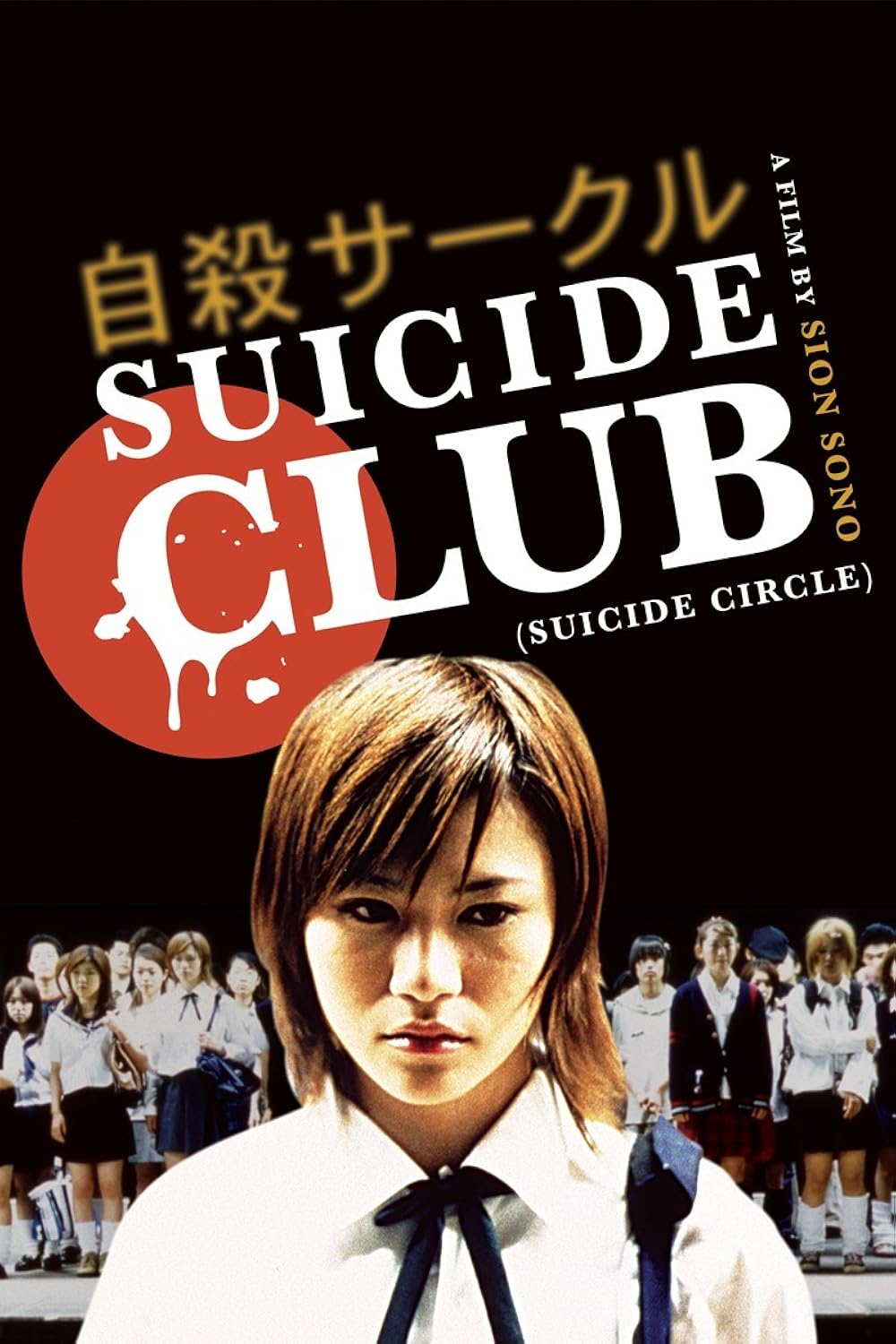
The 2001 Japanese Horror film Suicide Club/Suicide Circle contains subtle messages. An underlying uprising of suicide rates in younger people in the country.
It was directed and written by Shion Sono and released in 2001. Ryo Ishibashi is a detective. He is trying to find out the common thread between a wave of suicides that is sweeping across Japan. The police are following leads provided by a female hacker called “the bat. ” The authorities try to track down who is responsible for all the deaths.
The film opened with a large amount of notoriety and controversy. This was due to its subject and the amount of gore depicted on-screen. It quickly became a cult favourite. It spawned a sequel called Noriko’s Dinner Table which shows events prior to and after the first film. The film takes place over a six-day period starting on May 27th.
The Story
The film starts in the Shinjuku train station at platform 8. Being in the Japan the platforms are packed with people. The camera focuses on a large group of school girls all talking animatedly and entering the platform via the stairs. The girls are wearing a variety of school uniforms that indicates they are not all from the same school.
The Express train’s approach is announced on the loud speakers on the platform. The girls stop talking and laughing and all line up on the edge of the platform. As the Express train pulls up, the girls link hands and chant, “A-one, and a- two, and a three!” On three they all jump en masse in front of the speeding train.

In true Takashi Miike style there are gallons of blood and body parts a plenty. The train and the waiting passengers are covered in blood and it runs across the platform in a small wave. When I first saw that scene I felt that Sono was paying a sort of homage to Takashi Miike. Miike is well-known for his over-abundant use of blood and gore in his films.
*This opening scene still shocks, even though I’ve seen the film at least three times now. It is one helluva opening. Suicide Club both mesmerizes you and shocks you as the movie plays out.*
Back to the Story
The next suicide takes place in a quiet hospital where two young nurses are working late. After they both kill themselves, the security guard finds a white satchel with a “roll” of human skin. It has been stitched together. Oddly enough the exact same thing was found at the train station. The police have found their first thread.
Running through the entire film are popula of songs and music videos by a group of pre-teens. 12 and a half years-old according to the detectives daughter. The girls promiscuously dance and sing about love and seemingly death. When Detective Kuroda (Ishibashi) comes home, he calls a family meeting in the dining room. As his pre-teen son and daughter come into the room, his daughter turns on the television. The pre-teen music group instantly takes the point of focus with the two kids.

Singing
The group is called Dessert. *Although throughout the film the name changes repeatedly to Dessart and Desert.* Part of the problem when dealing with an Independent film company and subtitles. The group’s biggest hit at the start of the film is called Mail me. A song about love via the internet with the lyric, “If you don’t mail me, I’ll just die.”
As the film progresses, the group’s hit song changes to Jigsaw Puzzle. This is where the girls sing that “their piece doesn’t fit anyone.” Erotic suggestion aside, they sing that if they cannot find someone to “fit” their piece, they’ll go away forever.
Of course the viewer is immediately suspicious (at least this viewer was) of this little Lolita group. In the west versus the east where Lolita’s dress in pinafores and ruffles as a sort of role play. We begin to wonder if their songs and videos are transmitting subliminal messages telling kids to kill themselves.

Body Count
The body count begins to escalate. There are a few more “group” suicides but there are also single suicides. Like the mother who chops her fingers off while cutting what looks like a bread roll. Or the chap who throws himself off a building only to hit his girlfriend accidentally. He injures her before expiring on the pavement. Of course this incident becomes a plot point that will crop up later.
The computer hacker, the Bat, is trying to find out more information about who is behind the suicides. Suddenly, she and her sister are taken forcefully by a group of young men. They make her to tell the police that she has been kidnapped by the “Suicide Club.” The Bat was the person who discovered a website predicting how many suicides were going to occur. White dots were girls and red dots were boys. When the 54 girls threw themselves under the train at the beginning of the film, there were 54 white dots. This was the information that she passed on at the beginning of the film.
The Bat, whose real name is Kiyoko (Yôko Kamon) and her sister are taken. They are put in what appears to be a small bowling alley. The place is full of live things tied up in sheets. The sheets are all moving and the smaller ones are making noises like animals in distress. Kiyoko and sis meet Genesis (J-pop performer Rolly. He looks like a cross between a Glam-rocker and a visual Kei performer. Genesis informs the girls that this is his house of pleasure. He kills a couple of the smaller covered objects by stamping on them.
Death
He serenades the girls with a song about “death shining. ” One of his minions rape and kill a girl in another sheet. Genesis wants to be famous and wants to take the credit for motivating all the suicides in Japan. After allowing Kiyoko to start emailing the police about where she actually is, Genesis knocks her away from the keyboard. He tells the police himself where he is.

The police arrest Genesis, but find that he is not the perpetrator behind the suicides. Detective Kuroda loses the plot and then everything else. The film ends quite ambiguously and does not answer any real questions about what has been going on.
Let’s Talk Suicide Club
Watching the film again I could not decide if Sono was inferring that the internet was dangerous to our children. Or perhaps idolizing pre-teen girl bands was bad for you.
Considering the Japanese’s predilection of fancying the pants off of school girls it doesn’t seem too far-fetched an idea. The internet was just starting to come into its own in 2001. It makes sense that the people in charge would distrust its wide open access. Especially now that the US government alone is pushing for world-wide internet control. They want something equal to that of suppressed countries like China and Iraq.
My final analysis, if it can be called that, is that Sono wanted to show how dehumanized people have become. Whether it is through increased use of the internet or the worship of “sexualized” urchins. Ones who writhe suggestively and wink knowingly while singing about love and ending it all. Sono appears to be saying that we need to wake up and smell the coffee. He also seems to think we need to get in touch with ourselves as well.
Messages
Not to mention the sub-message about craving fame so much that you perform inhuman acts to attain it. Is this yet another form of dehumanization? Is Sono also warning us of the deadly lure of fame? It could well be, Suicide Club seems full of messages both subtle and not so subtle. This is above the actual message the the film seems to be relating to its characters, or the “plot message.”
The plot’s message appears to be that death will get you back in touch with “everything.” It is only through this finality that you are able to really live. After a third viewing, I have put the sequel, Noriko’s Dinner Table on my wish list. I want to see if it adds anything to the mix. Perhaps it will clarify the film’s overall message, or messages.

The Verdict
A definite 5 star film that should not be missed. Suicide Club is a perfect example of just how good independent J-horror can be, check it out. Just for the record, I watched the “uncut” version which has quite a bit of added gore. It can be streamed on Prime subscription channels and Fawesome.




Leave a Reply
You must be logged in to post a comment.